
Almost every forex robot you’ll ever see for sale comes with a backtest attached, and almost every one of those backtests looks fantastic. A rising equity curve, a healthy win rate, a profit factor that would make any fund manager jealous. If backtesting were as simple as running the numbers and believing the result, everyone selling an EA would already be retired.
The truth is that a backtest is only as good as the process behind it. Run one carelessly and you can make almost any strategy look profitable, purely by accident. Run one properly, with the right data, the right assumptions, and a healthy amount of scepticism, and it becomes one of the most useful tools you have for judging whether a robot deserves real money.
This guide walks through how to backtest a forex robot the way it should be done: what you need before you start, the steps to follow, the mistakes that quietly inflate results, and how to tell a trustworthy backtest from a misleading one.
What a Backtest Actually Tells You
A backtest simulates how a strategy would have performed if it had been running over a chosen stretch of historical data. That’s genuinely useful — it’s far better than guessing, and it lets you rule out strategies that clearly don’t work before you risk a penny on them.
What it can’t tell you is how the strategy will perform in the future. Markets change. The conditions that produced a strong backtest — a particular trend, a particular level of volatility, a particular relationship between currency pairs — may simply not repeat. A backtest is evidence of what happened once, in one specific slice of history, under one specific set of rules. It is not a guarantee, and treating it as one is where most of the disappointment with forex robots begins.
Before You Start: What a Fair Test Needs
A backtest is only as reliable as the inputs behind it. Before you trust any result — your own or one shown to you by a vendor — check that these boxes are ticked.
- Quality tick data. Cheap or incomplete historical data can misrepresent exactly when and at what price a trade would have filled, especially for strategies that rely on precise entries.
- Realistic spread and commission. A test that assumes zero cost, or today’s tight spread applied retroactively to a volatile period, will flatter almost any strategy.
- Slippage modelling. Fast markets rarely fill you at the exact price you wanted. A backtest that ignores this is quietly optimistic.
- A long enough period. A few months rarely covers more than one type of market condition. You want a stretch long enough to include calm periods, strong trends, and at least one sharp volatility spike.
- A broker-realistic execution model. Requotes, partial fills, and variable spread during news events all affect real results and are easy to leave out of a simulation.
How to Backtest a Forex Robot, Step by Step
- Define the rules before you look at any results. Write down exactly what the strategy does — entries, exits, stop loss, take profit, position sizing — before running a single test. If you find yourself tweaking rules based on what the equity curve looks like, you’ve stopped testing and started fitting.
- Choose a data source you trust. Use tick or high-quality minute data from a reputable provider rather than whatever comes bundled for free, particularly if the strategy trades on short timeframes.
- Set realistic costs. Enter the actual spread, commission, and swap you’d pay with your broker, not the best-case figures from a marketing page.
- Split your data before you begin. Set aside a portion of history — commonly the most recent 20-30% — that you won’t look at until the strategy’s rules are completely finalised. This becomes your out-of-sample test.
- Run the test on the in-sample data only. Build and refine the strategy using only the earlier portion of your data. Resist the urge to peek at the reserved period.
- Check the out-of-sample period once, and don’t tune afterwards. Run the finished strategy against the data you set aside. If performance holds up reasonably well, that’s a genuinely encouraging sign. If you immediately start adjusting the rules to fix what went wrong in that period, you’re no longer testing — you’re curve-fitting to a slightly bigger dataset.
- Forward test on a demo account before going live. A backtest, however careful, still relies on historical data and a simulated fill model. A demo account trading in real time, even for a few weeks, tells you things a backtest simply cannot.
Common Mistakes That Quietly Inflate Backtest Results
Most misleading backtests aren’t the result of deliberate manipulation. They’re usually the result of small, easy-to-miss shortcuts that each nudge the numbers in a flattering direction.
- Overfitting and curve fitting. Adjusting rules repeatedly until the backtest looks good effectively memorises the past rather than finding a genuine, repeatable edge. The more parameters a strategy has, the easier this is to do without realising it.
- Cherry-picked date ranges. Testing only over a period that happened to suit the strategy — a strong trend for a trend-follower, for instance — and leaving out the periods where it would have struggled.
- Ignoring transaction costs. Spread and commission matter far more to high-frequency strategies than low-frequency ones, and leaving them out (or understating them) can turn a losing system into an apparent winner on paper.
- Unrealistic fills. Assuming every order fills instantly at the exact requested price, with no slippage, particularly around news releases when real fills are often far worse.
- Survivorship bias in the data. Testing only on currency pairs or conditions that are still relevant today, having quietly dropped the ones where the strategy failed.
- Too short a track record. A few winning months proves very little. Strategies need to be tested across enough time and enough different conditions to mean anything.
Backtest Quality Checklist
Use this as a quick way to sanity-check any backtest — your own, or one shown to you by a vendor.
| Factor | Weak backtest | Strong backtest |
|---|---|---|
| Test period | A few months, one market condition | Several years, multiple conditions |
| Costs included | Zero or unrealistically low spread | Realistic spread, commission and slippage |
| Data quality | Free or low-resolution price data | Tick or high-quality minute data |
| Out-of-sample test | None — all data used to build the rules | A reserved period never touched during design |
| Number of parameters | Many, finely tuned | Few, kept deliberately simple |
| Drawdown reporting | Headline return only | Maximum drawdown shown alongside return |
Backtest vs Forward Test: Why One Isn’t Enough
A backtest and a forward test answer different questions. The backtest asks: “would this have worked on data we already know the outcome of?” The forward test asks: “does it hold up on data nobody, including the strategy, has seen yet?” The second question is the one that actually matters before you commit real money, and it’s also the one most sales pages quietly skip.
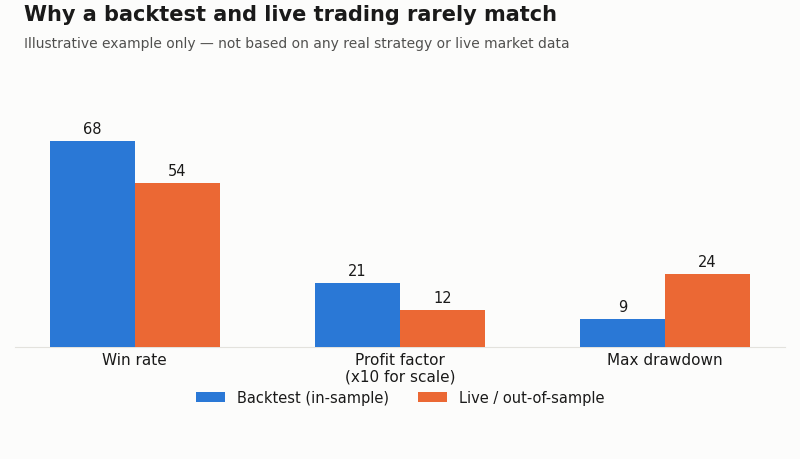
The gap between the two is usually where the truth about a strategy lives. A small, explainable drop from backtest to live performance is normal. A dramatic one — a healthy win rate turning into a losing system, or a modest backtested drawdown turning into a severe one — is a strong sign the original backtest was overfit, or that costs and execution weren’t modelled realistically.
The chart below illustrates the kind of gap that shows up repeatedly when strategies move from a backtest into live or out-of-sample conditions. It’s a hypothetical example built to demonstrate the pattern, not a real account or live market data.
Final Thoughts
A backtest is a genuinely useful tool, but only when it’s built honestly: realistic costs, quality data, a long enough period, and a proper out-of-sample test that wasn’t used to shape the rules. A backtest that looks too good to be true, with no reserved test period and no mention of drawdown, usually is.
Before you trust any forex robot’s backtest — including one you’ve built yourself — ask how the data was sourced, whether costs were modelled realistically, and whether any part of the test period was kept back until the rules were finished. If those questions can’t be answered clearly, treat the result as unproven rather than as a promise.
This article is for educational purposes and does not constitute financial advice. Trading forex carries a high level of risk and may not be suitable for all investors.
Leave a Reply