
Adverts for forex robots tend to follow the same script: a smiling trader, a screenshot of a rising equity curve, and a promise that the software does all the work while you sleep. It is an appealing pitch, and the honest answer to “do forex robots really work” is more nuanced than either the marketing or the sceptics suggest.
Some automated systems genuinely do what they say on the tin, at least for a while. Many others fail quietly, often in ways that are easy to miss until real money is on the line. The difference rarely comes down to luck alone — it comes down to understanding what a robot can and cannot do, and why an impressive backtest is not the same thing as a reliable trading edge.
This guide looks at the honest evidence: how forex robots actually work, why some hold up and most eventually don’t, and how to judge one before you trust it with your money.
What Is a Forex Robot, Exactly?
A forex robot, more formally an Expert Advisor (EA), is a piece of software that plugs into a trading platform such as MetaTrader and executes trades automatically according to a fixed set of rules. Those rules might be based on moving averages, breakout levels, momentum indicators, or a combination of several signals.
The appeal is obvious. A robot doesn’t get tired, doesn’t hesitate, and doesn’t let a bad morning affect its next decision. It applies the same logic at 3am as it does at 3pm, trade after trade, without needing to watch a screen.
The Honest Answer: It Depends What “Work” Means
If “work” means “execute a defined strategy consistently, without emotion, exactly as programmed,” then yes — that is precisely what forex robots are built to do, and they do it reliably.
If “work” means “generate consistent profit over the long run, in changing market conditions, without the strategy behind it eventually breaking down,” then the honest answer is: rarely, and usually not for as long as the marketing implies.
A robot only ever automates a strategy — it doesn’t invent one, and it can’t tell you whether the underlying strategy still has an edge once market conditions shift. That distinction explains most of the disappointment traders experience with automated systems.
Why Some Forex Robots Can Work, At Least for a While
It would be inaccurate to say automation never helps. There are genuine mechanisms by which a well-built robot can add value:
- It removes emotional decision-making — no revenge trading after a loss, no hesitating on a valid signal out of fear.
- It applies position sizing and stop losses with total consistency, trade after trade.
- It can react to price movements in milliseconds, which matters for strategies that rely on speed, such as scalping around news releases.
- It can monitor multiple currency pairs simultaneously, something a manual trader simply cannot do around the clock.
- Its logic can be tested systematically before any real money is risked, which is harder to do with a discretionary, gut-feel approach.
Robots built around simple, well-understood mechanics — trend-following on liquid major pairs, for example — tend to be the ones with the best chance of holding up over time, precisely because they aren’t trying to exploit some fragile, short-lived quirk in the market.
Why Most Forex Robots Eventually Stop Working

The less comfortable evidence is that most commercially sold forex robots underperform their marketing, and a large proportion lose money over a long enough live track record. There are consistent, explainable reasons why.
- Overfitting. Many robots are tuned so precisely to historical data that they’ve essentially memorised the past rather than found a genuine, repeatable edge. The strategy looks flawless on the exact data it was built on, and falls apart the moment conditions change.
- Market regime shifts. A robot built during a strong trending period can struggle badly once markets turn choppy and range-bound, or vice versa. Very few strategies work equally well in every environment.
- Execution differences. A backtest often assumes perfect fills at the exact advertised price. Live trading involves spread, slippage and latency, all of which quietly erode returns that looked fine on paper.
- Misaligned incentives. Many robots are sold, not traded, by their creators. A vendor earns money from the sale itself, which is a very different incentive from earning money by running the system on their own capital.
- Risky staking methods. Some robots rely on martingale or aggressive grid-style position sizing to smooth out their equity curve. This can produce an attractive-looking track record for a long time, right up until a losing sequence causes a very large drawdown.
Marketing Claims vs What the Evidence Actually Shows
Sales pages for forex robots tend to lean on a familiar set of claims. It’s worth holding each one up against what independent scrutiny typically finds.
| Marketing Claim | What the Evidence Usually Shows |
|---|---|
| “Verified 90%+ win rate” | Win rate alone says nothing about size of losses; a high win rate can still lose money overall if the rare losers are large. |
| “No losing months on record” | Often based on a cherry-picked or short backtest period; live forward-testing frequently reveals losing streaks the backtest never showed. |
| “Fully automated — set and forget” | Still needs monitoring for broker outages, spread changes, news events and shifting market conditions the logic wasn’t built for. |
| “Backtested over 10+ years” | A long backtest reduces, but doesn’t eliminate, overfitting — and says nothing about live execution quality. |
| “Guaranteed profits” | No trading system, automated or otherwise, can guarantee profit. This phrase alone is a reliable warning sign. |
Backtested Results vs Live Forward-Tested Results
The single biggest gap between expectation and reality with forex robots is the difference between a backtest and genuine forward performance. A backtest runs a strategy against historical data it already knows the outcome of. A forward test — running the same robot on new, unseen data, ideally on a live or demo account — is the real test of whether the edge holds up.
The chart below illustrates the kind of gap that shows up again and again when robots move from backtest to live trading. It is a hypothetical example, not a real system, but the pattern — smaller returns, larger drawdowns, more losing months once real conditions and execution enter the picture — is extremely common.
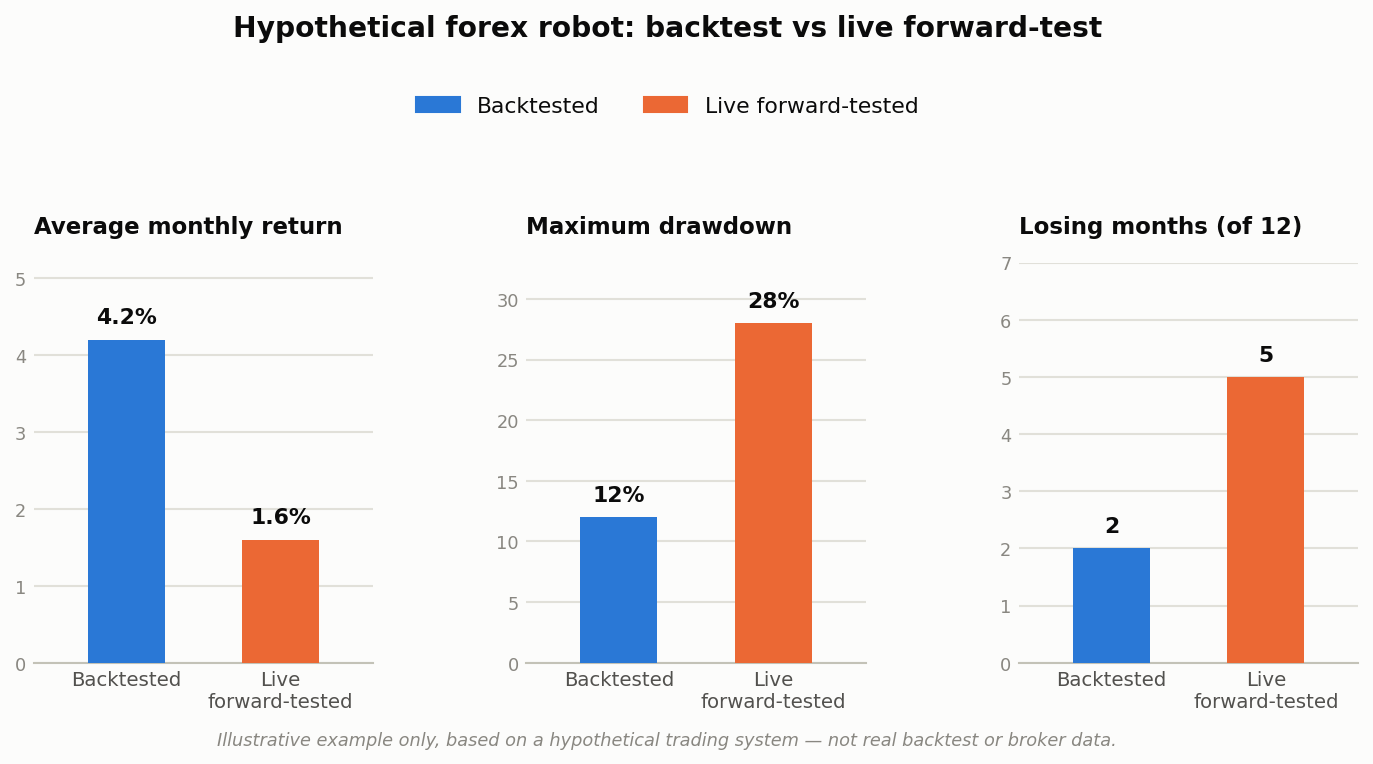
Notice the shape of the gap: return falls, drawdown rises, and losing months increase. That pattern isn’t inevitable, but it is common enough that any robot without a meaningful live, forward-tested track record should be treated as unproven — regardless of how convincing its backtest looks.
How to Judge Whether a Specific Robot Might Work
None of this means automation is a dead end. It means the burden of proof should sit with the evidence, not the sales copy. Before trusting a forex robot with real money, work through the following.
- Look for a live, forward-tested track record — ideally a year or more — rather than relying on a backtest alone.
- Check the maximum drawdown, not just the profit figure. A system that can lose 40% of an account before recovering carries very different risk to one that stays within 10–15%.
- Understand the underlying logic, at least broadly. If a vendor won’t explain roughly how the strategy makes decisions, treat that as a warning sign rather than proprietary genius.
- Check whether it uses martingale or grid-style staking. These methods can mask real risk behind a smooth-looking equity curve.
- Test it yourself on a demo account first, over a meaningful stretch of time and a range of market conditions, before committing real capital.
- Ask what conditions the strategy needs to work. A robot built for strong trends will typically struggle in quiet, range-bound markets, and vice versa — no system performs equally well in every environment.
Final Thoughts
Forex robots really do work, in the narrow sense that they execute a defined strategy with total consistency, at any hour, without emotion clouding the decision. What they cannot do is guarantee that the strategy behind them keeps working once real market conditions, execution costs and time all come into play.
The traders who get genuine value from automation tend to be the ones who treat a robot’s backtest as a starting hypothesis rather than a promise, insist on live forward-tested evidence before risking meaningful capital, and understand exactly what conditions the strategy needs in order to have a real edge. Trading, automated or not, always carries the risk of loss — a robot changes how a strategy is executed, not whether that risk exists.
Leave a Reply