A prop firm challenge offers an appealing trade. Pay a fee, pass an evaluation, and trade the firm’s capital for a share of the profit.
The funded trading industry has grown quickly, and plenty of firms deliver exactly what they promise. Others are built to profit from the fee itself, whether or not a trader is ever paid out.
This guide covers the structural red flags worth checking before you hand over a challenge fee, and links through to two guides that matter once you are trading a funded account: our piece on acceptable drawdown and our guide to verifying a track record yourself.
Why the Model Makes Scams Easy
Most firms run their evaluation phase, and often the funded phase too, on an internal or simulated account rather than placing live trades in the market. Many disclose this openly in their terms, and it is standard practice across the industry rather than proof of wrongdoing on its own.
It does change the incentives, though. A firm earns money from challenge fees whether or not anyone passes, which means growth can come from selling evaluations rather than from trading skill.
That is not automatically a problem. It becomes one when a firm’s rules, support and payout behaviour suggest the fee is the whole business model.
Red Flag 1: A Profit Split That Sounds Better Than It Pays
Many firms advertise headline splits of 80 to 90 percent. The number alone means little without knowing how quickly it is reached, whether it resets, and what counts as a “payout-eligible” trade.
Watch for a split that only applies after a scaling threshold most traders never reach, or one that quietly resets every time an account is reset or an extension is purchased.
Red Flag 2: Payout Delays, Excuses and Disappearing Support
A first payout request is the real test of any firm, and it is also where problems tend to surface.
Look for patterns in independent reviews: payouts that take far longer than advertised, support that goes quiet once a payout is requested, or accounts suddenly flagged for a rule breach right before money is due.
One or two slow payouts could be a staffing problem. A consistent pattern, repeated across many unconnected traders, is a business model.
Red Flag 3: Rules That Shift Once You’re Close to a Payout
Most funded programmes include a consistency rule, a minimum number of trading days, and restrictions on holding trades over news events or weekends. These exist at reputable firms too, and are not themselves a red flag.
The red flag is enforcement that only seems to bite once an account is profitable. A rule applied loosely during the evaluation and then suddenly, retroactively, strictly during a payout review is a pattern worth asking about directly.
Read the full rulebook before you pay, not just the marketing page. If a rule is vague enough that the firm could interpret it either way, assume it will be interpreted against you when money is involved.
Red Flag 4: No Clear Business Behind the Brand
It is reasonable to expect a registered company, a verifiable trading address, and named people behind a firm handling challenge fees and payouts.
The same anonymity problem that shows up in warning signs in signal providers shows up here. A slick website and an active social media presence are not evidence of a real, accountable business.
Search the firm’s name alongside “payout”, “withdrawal” and “scam” before paying. A pattern of unresolved complaints is more informative than any single bad review.
Red Flag 5: A Fee Structure That Only Makes Sense If You Fail
Reset fees, extension fees, and “retry at 50 percent off” emails are common across the industry and are not inherently dishonest.
They become a concern when they make up most of a firm’s visible revenue, or when its marketing leans more heavily on discount codes and flash sales than on the trading opportunity itself.
A firm genuinely built around funding good traders wants people to pass. One built around fees wants people to keep buying challenges.
Red Flag 6: Heavy Affiliate and Referral Incentives
Some firms pay large, multi-tier commissions to anyone who refers a new challenge buyer, with rewards tied to sign-ups rather than funded traders going on to succeed.
Affiliate programmes are common and not inherently dishonest. The concern is a firm whose growth and visible marketing depend more on this referral chain than on traders actually getting funded and paid.
If every review and social post you find leads back to an affiliate link rather than independent commentary, treat the apparent popularity as marketing reach, not evidence of a good service.
What the Funnel Usually Looks Like
No independent body publishes verified, industry-wide prop firm pass rates, so treat any specific percentage you see quoted, including the illustrative one below, as a rough shape rather than a fact about any real firm.
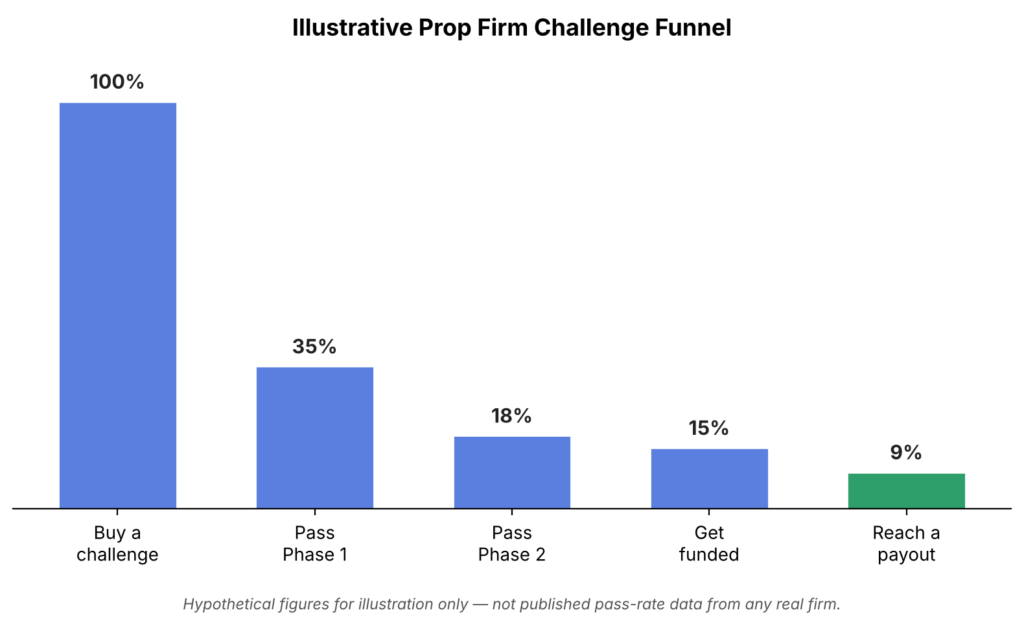
The pattern that recurs across trader forums, and among the firms that do publish their own numbers, is a steep narrowing at every stage: most challenge buyers fail the first phase, a smaller group clears the second, and a smaller group again ever reaches a payout.
That narrowing is not, by itself, evidence of a scam. It is close to what you would expect given how hard consistently profitable trading actually is. The red flags above are about what happens around that funnel, not the shape of the funnel itself.
A Worked Example
Take the hypothetical funnel above and a $150 challenge fee. If 1,000 people buy the challenge, roughly 350 clear phase one and about 90 eventually reach a payout, based on the illustrative figures shown.
That is $150,000 in challenge fees collected from 1,000 buyers, against whatever profit split the firm eventually pays out to the roughly 90 who get funded and trade profitably. Even a generous split works out very differently for the firm than for any individual trader hoping to be one of the 90.
This is simple arithmetic, not evidence about any real firm’s finances. It explains why fee income alone can sustain a business regardless of trading outcomes, and why marketing that emphasises the headline split over the realistic odds of reaching it is worth treating carefully.
Legitimate Firm vs Red-Flag Firm
| Signal | Legitimate firm | Red-flag firm |
|---|---|---|
| Rulebook | Clear, fixed, available before you pay | Vague, changes, or only strictly enforced near payout |
| Payouts | Processed on a published schedule, confirmed by independent reviews | Delayed, excuse-driven, or disputed in reviews |
| Business info | Named company, registered address, findable leadership | Anonymous ownership, no verifiable address |
| Marketing | Focuses on trading conditions and support | Focuses on discount codes and urgency |
| Response to scrutiny | Transparent about simulated accounts and rules | Evasive or defensive when asked direct questions |
How to Check a Prop Firm Before You Pay
- Read the full rulebook, not just the marketing page, before paying. Pay particular attention to the consistency rule, minimum trading days and any news or weekend restrictions.
- Search the firm’s name alongside “payout”, “withdrawal” and “scam” on independent forums, not just its own testimonials page.
- Confirm who owns the company: a registered business name, an address, and named people, not just a logo and a Discord server.
- Ask directly whether the evaluation and funded accounts trade live or simulated capital, and check the answer matches what is written in the terms.
- Start with the smallest challenge size the firm offers, to test support, rule enforcement and payout speed before committing to a larger one.
- Apply the same scepticism to a firm’s published pass-rate or payout statistics that you would to a trader’s claimed track record — ask where the number comes from and over what period.
Key Takeaways
A prop firm challenge is not inherently a scam, and most of the structures that make people uneasy, such as simulated accounts, reset fees and consistency rules, are standard across reputable firms too.
The red flags are about conduct, not the model: rules enforced only at payout time, support that disappears when money is due, anonymous ownership, and marketing built around urgency rather than trading conditions.
Read the rulebook before you pay, start small, and treat a firm’s own statistics with the same scepticism you would apply to spotting fake trading results.
This article is for educational purposes and does not constitute financial advice. Funded trading challenges and forex and stock trading generally carry a high level of risk, including the potential loss of the full amount invested, and may not be suitable for all investors.